 By Admin
Writing an academic paper involves more than collecting information and explaining your ideas. You also need to show where your information comes from. If you use another writer’s ideas, research, or exact words without giving proper credit, your work may be considered plagiarism. This is why learning how to use an MLA in-text citation is important for students, researchers, and academic writers.
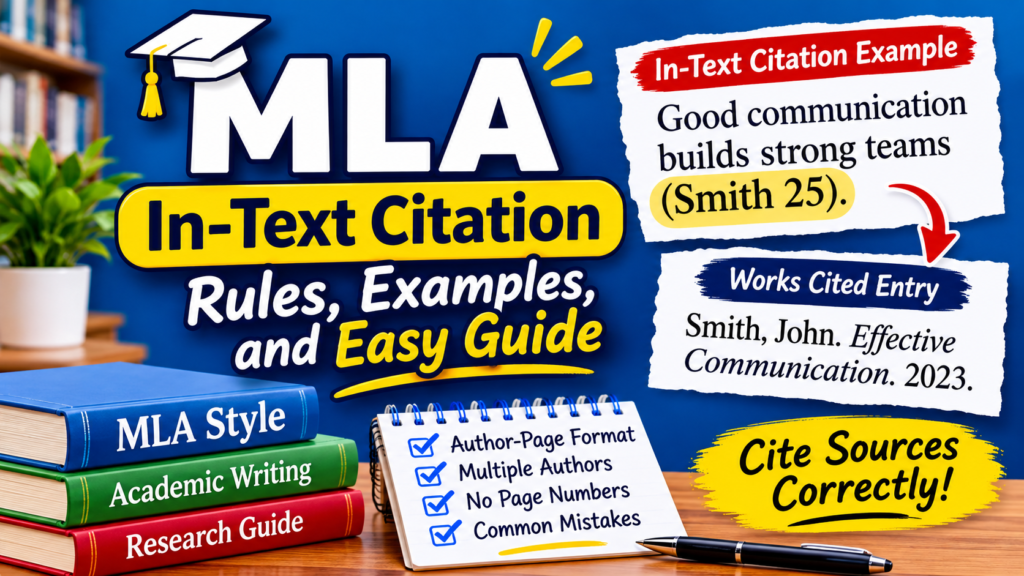
MLA in-text citation is a method of giving credit to sources directly inside your writing. It helps readers identify the books, articles, websites, and other materials you used while preparing your work. The Modern Language Association (MLA) uses an author-page system in most cases. This means you usually include the author’s last name and the relevant page number in parentheses.
For example, if you use information from page 25 of a book written by Johnson, your citation will look like this: (Johnson 25).
Although the basic format is simple, different sources require different citation methods. A book with one author is not cited in exactly the same way as a website without an author or a journal article written by several researchers.
This guide explains MLA in-text citation rules in simple language. You will learn how to cite different sources, where to place citations, how to handle missing information, and how to avoid common formatting mistakes.
What Is an MLA In-Text Citation?
An MLA in-text citation is a short reference placed within an essay, research paper, or other academic document. It tells readers where a particular idea, quotation, or piece of information originally came from.
Instead of adding the complete source details every time you mention another writer’s work, MLA uses a short citation inside your paragraph. The full information is provided separately on the Works Cited page at the end of your document.
For example:
According to Johnson, regular reading can improve vocabulary and writing skills (42).
In this example:
- Johnson is the author’s last name.
- 42 is the page number where the information can be found.
- The complete publication details should appear in the Works Cited list.
MLA citations help readers check your sources and understand which ideas belong to you and which come from other writers.
You should use an in-text citation when you directly quote another source or explain its information in your own words. Changing the wording does not remove the need to give credit.
Understanding the MLA Author-Page Format
The most common MLA in-text citation format is known as the author-page method. It normally includes the author’s last name followed by the page number in parentheses.
The basic format is:
(Author’s Last Name Page Number)
Example:
Good communication plays an important role in successful teamwork (Brown 36).
Notice that there is no comma between the author’s name and the page number. You also do not need to write the word “page” or use abbreviations such as “p.” or “pp.” in a standard MLA parenthetical citation.
When the Author’s Name Is Already in Your Sentence
You do not need to repeat the author’s name in parentheses if you have already mentioned it in your sentence. In that situation, include only the page number.
Example:
Brown explains that good communication plays an important role in successful teamwork (36).
This format keeps your writing natural and avoids repeating the same information.
When the Author’s Name Is Not in Your Sentence
If you have not mentioned the author’s name, include both the author’s last name and the page number in parentheses.
Example:
Good communication plays an important role in successful teamwork (Brown 36).
Both examples identify the same source. The difference is where the author’s name appears.
How to Place an MLA In-Text Citation
The location of an MLA citation matters because readers need to understand which information comes from a particular source.
For a regular quotation or paraphrase, place the citation before the sentence’s final punctuation.
Example:
Online learning gives students more flexibility when managing their studies (Wilson 18).
You can also introduce the author in your sentence and place the page number after the quoted or paraphrased information.
Example:
Wilson explains that online learning gives students more flexibility when managing their studies (18).
MLA Citations for Direct Quotes
A direct quotation uses the exact words of another writer. You should place quotation marks around a short quotation and add the relevant citation.
Example:
The researcher describes education as “an important part of personal development” (Wilson 29).
Always copy quotations accurately. If you change or remove words, follow MLA rules for showing those changes.
MLA Citations for Paraphrased Information
Paraphrasing means explaining another person’s ideas in your own words. Even when you do not use the original wording, you must give credit to the source.
Example:
Wilson explains that education can help people develop useful skills and improve their opportunities (29).
The sentence uses different wording, but the idea comes from another writer. Therefore, the citation is still necessary.
MLA In-Text Citation Examples for Different Numbers of Authors
The number of authors affects how you format an MLA citation. A source may have one writer, two writers, or a larger research team.
1. Source With One Author
For a source with one author, use the author’s last name and the page number.
Example:
Reading regularly can improve a person’s ability to understand complex information (Taylor 45).
If you mention the author in your sentence, include only the page number in parentheses.
Example:
Taylor explains that regular reading can improve the ability to understand complex information (45).
2. Source With Two Authors
When a source has two authors, include both last names in the citation. Use the word “and” between their names.
Example:
Students often benefit from clear learning goals and regular feedback (Taylor and Smith 52).
If both authors are mentioned in your sentence, you can place only the page number in parentheses.
Example:
Taylor and Smith explain that clear learning goals can improve student progress (52).
3. Source With Three or More Authors
For a source with three or more authors, use the first author’s last name followed by the abbreviation “et al.”
Example:
Research shows that effective study habits can support academic progress (Taylor et al. 61).
The abbreviation “et al.” means “and others.” It helps keep citations short when a source has several contributors.
Quick MLA Citation Table
| Number of authors | Citation format |
|---|---|
| One author | (Taylor 25) |
| Two authors | (Taylor and Smith 25) |
| Three or more authors | (Taylor et al. 25) |
These formats follow the MLA 9 author-page system.
How to Cite a Website in MLA Without Page Numbers
Many online sources do not have traditional page numbers. For example, websites, online news articles, and digital publications may display information on a continuous webpage.
In such cases, do not invent a page number or use the number shown by your browser.
If the website has a named author but no numbered sections, cite the author’s last name.
Example:
Online education has become an important option for students who need flexible learning arrangements (Taylor).
If you have already mentioned the author in your sentence and no location information is available, you generally do not need an additional parenthetical citation.
Example:
Taylor explains how online education provides flexible learning opportunities for students.
What If an Online Source Has Numbered Sections?
Some digital publications divide their content into numbered sections, chapters, or paragraphs. If these numbers are provided by the source, you can use the appropriate location information.
Example:
(Taylor, sec. 4)
For a video, you can use a relevant timestamp.
Example:
(Taylor 12:35–13:10)
Only use location details that are actually available in the source.
How to Cite Sources With No Author in MLA
Sometimes you may find useful information on a website, article, or publication that does not identify an individual author.
In this situation, use a shortened version of the source title in your in-text citation. The title should match the beginning of the corresponding Works Cited entry.
For a short article or webpage title, use quotation marks.
Example:
Regular exercise can support physical and mental well-being (“Benefits of Exercise”).
For a complete book or another independent work, use italics instead of quotation marks.
Example:
The book discusses the importance of developing healthy habits (Healthy Living 32).
Important Rules for Missing Authors
- Do not invent an author’s name.
- Check whether an organization is credited as the author.
- Use a shortened title when no author is available.
- Keep the title consistent with the Works Cited entry.
- Do not include unnecessary words from a long title.
These rules help readers find the correct source even when an individual writer is not identified.
How to Cite an Organization or Corporate Author
Some reports, research papers, and online publications are written by organizations instead of individual authors.
Examples include government departments, universities, research institutions, and nonprofit organizations.
When an organization is listed as the author, you can use its name in the in-text citation.
Example:
The report explains that access to education remains an important development goal (World Health Organization 14).
If the organization has a long name, an appropriate abbreviation may be used when it is clear to readers and consistent with the Works Cited entry.
Make sure the organization name used in your citation matches the author information in your source list.
How to Cite Multiple Sources in One MLA Citation
Sometimes a single statement is supported by information from more than one source. MLA allows you to include multiple references in one set of parentheses.
Separate each source with a semicolon.
Example:
Regular physical activity can improve health, while balanced nutrition supports overall well-being (Taylor 28; Wilson 41).
This example uses two different sources to support one statement.
If you have several sources with different authors, arrange the citations in a clear order that helps readers identify each reference.
How to Cite Multiple Works by the Same Author
An author may publish several books, articles, or research papers. If you use more than one of these works, readers need a way to identify which publication supports your statement.
MLA handles this by including a shortened version of the title after the author’s last name.
Example:
Good writing requires planning and revision (Taylor, Writing Skills 24).
Another publication by the same author may be cited as:
Strong communication skills can improve professional relationships (Taylor, “Communication at Work” 16).
Use italics for the titles of complete works, such as books, and quotation marks for shorter works, such as articles.
This method prevents confusion when several Works Cited entries begin with the same author’s name.
How to Cite Two Authors With the Same Last Name
Sometimes different writers have the same last name. If you cite both authors, using only their surnames may make it difficult to identify the correct source.
In this situation, add the first initial of each author.
Example:
(A. Taylor 22)
(J. Taylor 38)
If both authors also share the same first initial, use their full first names to make the distinction clear.
This rule is especially useful when writing research papers that use several academic publications.
How to Cite an Indirect Source in MLA
An indirect source is information that you find quoted or discussed inside another publication.
For example, you may read a research article that includes a quotation from a different researcher. If you cannot access the original publication, MLA provides a way to identify the source you actually consulted.
Use the abbreviation “qtd. in,” which means “quoted in.”
Example:
According to Miller, education can influence social development (qtd. in Wilson 45).
In this example, Miller is the original speaker, while Wilson is the writer of the source you actually read.
The Works Cited page should include the source you consulted directly.
Whenever possible, try to find and read the original publication before using an indirect quotation. This helps you avoid mistakes caused by incomplete context.
MLA In-Text Citations for Poems, Plays, and Other Numbered Works
Not every source uses ordinary page numbers. Poetry, plays, and literary works may use other systems to identify specific passages.
For example, a poem may use line numbers, while a play may use act, scene, and line numbers.
Citing a Poem
When citing a poem with numbered lines, use the word “line” or “lines” in the first citation when needed to make the location clear.
Example:
The poet presents nature as a powerful source of inspiration (Smith, lines 12–15).
Citing a Play
For a play with numbered acts, scenes, and lines, use the relevant numbers separated by periods.
Example:
The character expresses doubt about the decision (Shakespeare 2.3.45–48).
Citing a Chapter or Section
For sources divided into numbered chapters or sections, use an appropriate abbreviation.
Examples:
- (Wilson, ch. 4)
- (Taylor, sec. 2)
Always follow the numbering system provided by the source. Do not create your own location numbers.
MLA In-Text Citation vs. Works Cited
Many students confuse in-text citations with Works Cited entries. Although they are connected, they have different purposes.
An in-text citation is a short reference inside your writing. A Works Cited entry gives readers the complete publication details.
Consider this example:
In-text citation:
Regular reading helps people improve their language skills (Taylor 35).
Works Cited entry:
Taylor, John. Developing Better Reading Skills. Academic Press, 2023.
The in-text citation identifies the source as Taylor’s work and points to page 35. The Works Cited entry provides the full publication information.
Every source cited in your paper should have a matching Works Cited entry, and each entry should be connected to the relevant citations in your writing.
The Works Cited page normally appears at the end of your paper. It uses alphabetical order based on the first element of each entry.
Common MLA In-Text Citation Mistakes to Avoid
Even students who understand the basic author-page format can make small formatting mistakes. These errors may make academic writing less consistent and harder to check.
Here are some common problems to avoid.
1. Adding a Comma Between the Author and Page Number
Incorrect: (Taylor, 25)
Correct: (Taylor 25)
MLA normally does not place a comma between the author’s last name and the page number.
2. Using the Wrong Author Format
Incorrect: (Taylor & Smith 25)
Correct: (Taylor and Smith 25)
Use “and” rather than an ampersand in a standard MLA in-text citation.
3. Adding a Page Number That Does Not Exist
Do not make up page numbers for online articles that do not have numbered pages. Use the author’s name or another valid locator when available.
4. Forgetting to Cite Paraphrased Information
Changing the wording does not make another person’s idea your own. Always cite the original source when you paraphrase.
5. Using the Full Title Every Time
Long source titles can make your writing difficult to read. Use an appropriate shortened title in the citation.
6. Forgetting the Works Cited Entry
An in-text citation should connect to a complete source entry. Check that the author or title used in your paragraph matches the corresponding entry.
7. Placing the Citation After the Wrong Punctuation
For a regular quotation or paraphrase, the parenthetical citation usually comes before the final period.
Incorrect: The study explains the importance of education. (Taylor 25)
Correct: The study explains the importance of education (Taylor 25).
For a block quotation, MLA uses a different placement rule: the citation follows the quotation’s final punctuation.
Practical Tips for Writing Correct MLA Citations
Good citation habits can save time when you prepare essays and research papers. Instead of waiting until the end of your assignment, record source information as you research.
Here are some useful practices:
Keep source details together: Record the author’s name, title, publication date, and page number when you find useful information.
Use original sources: Whenever possible, read the original book, article, or research paper instead of relying on someone else’s quotation.
Check every citation: Make sure the author name and location information match the source you used.
Be consistent: Follow the same MLA formatting rules throughout your paper.
Separate your ideas from source material: Make it clear when you are presenting your own opinion and when you are explaining another writer’s work.
Review the latest MLA guidance: MLA rules can be updated, so consult the official MLA Handbook or a reliable academic writing guide when you are unsure about a special case.
Frequently Asked Questions About MLA In-Text Citation
What is the basic format for an MLA in-text citation?
The basic format is the author’s last name followed by the page number in parentheses. For example: (Taylor 25). If the author’s name already appears in the sentence, include only the page number.
Do MLA in-text citations always need page numbers?
No. Page numbers are included when the source provides them and they help locate the information. For an online source without page numbers or another numbered system, use the author’s name or shortened title as appropriate.
How do I cite a website in MLA?
If a website identifies an author, use the author’s last name in the citation. If no author is listed, use a shortened version of the webpage title. Include a page number only when the source actually provides one.
How do you cite two authors in MLA?
Include both authors’ last names with the word “and” between them. For example: (Taylor and Smith 25).
How do you cite three or more authors in MLA?
Use the first author’s last name followed by “et al.” For example: (Taylor et al. 25).
Where does an MLA citation go in a sentence?
For a regular quotation or paraphrase, place the parenthetical citation before the final punctuation. For a block quotation, place it after the final punctuation.
Do I need an MLA citation when I paraphrase?
Yes. You must cite a source when you paraphrase another person’s ideas, even if you use completely different wording.
What happens if a source has no author?
Use a shortened version of the source title in the citation. Use quotation marks for shorter works and italics for complete works.
What is the difference between MLA and APA in-text citations?
MLA generally uses the author-page system, while APA uses the author-date system. For example, an MLA citation may look like (Taylor 25), while an APA citation may look like (Taylor, 2023).
Is MLA 9 still used?
Yes. The ninth edition of the MLA Handbook remains the basis for MLA 9 formatting. Students should follow the edition required by their school, college, or instructor and check official MLA guidance for any later updates.
Final Thoughts
Learning how to use an MLA in-text citation is an important part of academic writing. It allows you to give proper credit to authors, support your arguments, and help readers find the original information behind your research.
The author-page format is the foundation of MLA citations, but you should also understand how to cite multiple authors, online sources without page numbers, missing authors, and indirect quotations.
The best way to improve your citation skills is to practice with different types of sources and check your formatting before submitting an assignment.
Remember that correct citations are more than a formatting requirement. They show respect for other writers’ work and help make your own academic writing trustworthy.